Category Archives: Mackay

Transport

The 1920’s saw the arrival of the car in Mackay. Transport had always been a difficulty for people wanting to travel into Mackay from surrounding districts. Bridges were low level and subject to flooding. The Mackay Railway was completed and opened on the 10 August 1885. Locos, an engine with metal cane bins attached, (at first steam then diesel) took cut sugar cane from the cane fields to the Mill for crushing. It was not until the mid-1970’s that a higher level bridge was built across the Pioneer River at Mia Mia that would enable Locos and cars to travel from Mia Mia to Mirani.

Sugar Industry

Following the exploration and discovery of the Mackay district credited to John Mackay in 1860, very little of the original land was being used for cattle grazing within 20 years of that discovery. The first ton of sugar was made at Captain Louis Hope’s sugar plantation at Ormiston, Cleveland in September 1864.’

In the early days of sugar growing many individual steam mills sprang up to crush sugar for market. The Sugar and Coffee Regulations of 1864 accelerated the growth of the sugar industry in Mackay. One of the first plantations ‘Alexandra’ was owned by Thomas Henry Fitzgerald. In 1975 a disease called ‘rust’ devastated the sugar plantations and many went into receivership. The first central mill to be built at North Eton was closed in 1988. Sugar cane from Mia Mia went to North Eton Mill until the Mill closed.

New Australians

‘New Australians’ is a term used in North Queensland to acknowledge people who arrive from overseas to live in Australia. In 1988 the population in Queensland was 213,525 growing to just over a million people in 1954. The earliest settlers in Mia Mia arrived in 1883. A plaque at the Mia Mia Park commemorates some of these early settlers.

The British Isles furnished the greatest number of people arriving in the Shire of Mirani for the year 1921. Germany provided the second highest number of people arranging in the Shire followed by Polynesia, Italy and then Sweden. Again in 1933, England provided the greatest number of New Australians followed almost equally by Scotland and Ireland with again Germany, Italy and New Zealand. This trend continues in the following decades with a slight increase in the number of Italians and Maltese arriving in the Shire. In 1966 the Maltese overtook the number of people arriving from Italy with an ever slight increase in the number of people coming from Malta in 1971.

Impact of Climate

Mia Mia is one hour’s drive from Mackay in North Queensland, which means the same humid subtropical climate with maximum temperatures around 30 degrees C and a minimum of around 23 degrees C in winter. The minimum temperature seldom drops below 2 degrees C. Spring is usually more dry and hot and humid than winter. The heavy downpours usually arrive later in the summer with the wet season traditionally starting in December. The locals are currently predicting the wet season is coming later than previously. Cyclones occur occasionally often with devastating effect on people and property.

An unusually wet season was experienced in 1863 with a cyclone the following year. The Islands in the North bore the brunt of the bad weather. Cyclone Éline’ damaged Mackay buildings in 1893 ‘the mortuary chapel at the cemetery was blown over and alarmingly the old city brewery in Shakespeare Street collapsed with damage to the machinery’.

Drought followed in 1897. The Great cyclone of 1918 cost the lives of 30 people and casualties of over 200. Buildings were the major casualties in Mackay with residents isolated for four days having now power and water for two weeks. It was a week before the sun came out again.

The Cremorne Aboriginal camp was ‘wiped out; the Leap School collapsed; the Eimeo Hotel lost its roof; sustained its visitors on ‘wallaby, a little tea and rice, and a biscuit or slice of bread.’
Worst hit was Finch Hatton where the school; halls; two sawmills; a factory and a number of houses were demolished. The surrounding areas all within range of Mia Mia; those of Pinnacle, Eton, Mirani and Walkerston suffered severe damage. Te Kowai Mill closed permanently.

Recalling the severe flood of 1958, when living on a cane farm at Mia Mia close to the bank of the Pioneer River, the family almost had to climb onto the roof of the house to escape the flooding. There was the slim possibility of one of the neighbours being able to reach us in a dingy but it did was not necessary even though the river had burst its banks not far from our house. A “hair raising experience” as my mother could not swim and being the eldest at 10 years of age; their were four other children and it occurred at mid-night. We may not have survived.
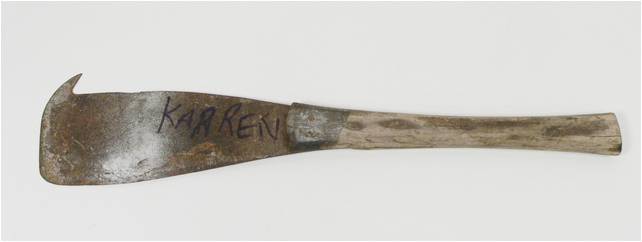
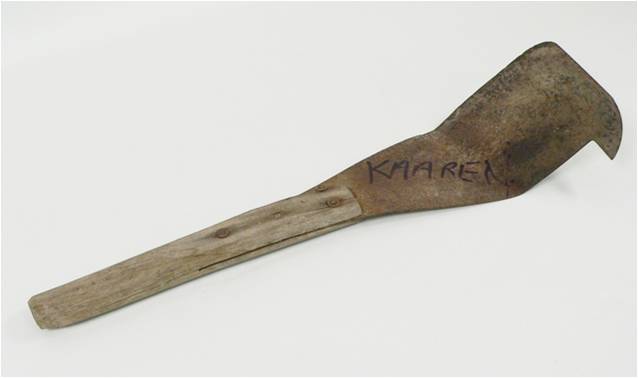
Manual to Mechanical Cane Cutting

Prior to mechanical harvesting, cane cutting was seasonal work with the influx of men to the Mackay district during the months from May to November each year for the period of time that the “crushing” took place in the cane fields. These men needed to be housed and fed for the long days they spent doing hard physical labour. The cane farmer provided accommodation in cane barracks with the wives and daughters of farm owners or managers providing early breakfasts and late dinners. It is not true that cane cutters did not wear shoes. They wore sand-shoes on their feet.

The hard physical labour meant blisters on the hands for the first three weeks until the skin hardened to take the constant use of a cane knife.  A number of remedies were used to alleviate the blisters but it was largely a matter of waiting for the calluses to build up on the skin. There were at least two different types of cane knives; one was a cutter that had a bent blade and the other was a topper that had a longer straight blade. The cutter was used to cut the cane off at the ground level after the cane had been burnt at sunset the night before, and the topper was used by the men to cut the tops from the cane prior to loading the bins for transporting by loco (sugar train) to the sugar mills. In the early days of the industry, horses were used to transport sugar cane to mills. The reason given at the time for burning the rubbish from around the cane was to increase the sugar content; add nutrients in the soil as well as to clear the cane of any pests such as taipan snake and rats. Harvested cane is now cut green without the need for burning the cane.

Technological change has allowed for the development of mechanical equipment to assist farmers. The first patent lodged for a mechanical cane harvester was in 1958 by Fields Pty Ltd of Mackay. Hodge Industries also of Mackay developed a range of patented mechanical equipment with creative inventions still being developed. The farming industry has become computerised to allow a single farmer to manage a cane farm with the aid of mechanical harvesters and tractors that have sensors and GPS navigational aids.

Cane knife - TopperCane knife - Chopper

Role of Women in Agriculture

Women play a significant role in an agricultural community as paid or unpaid workers whether full or part-time, for those families who need a second income; as home makers and mothers. Women are largely economically dependent on men. Those women who have a higher level of education are more likely to obtain higher paid work than those women who do not. The role of women who marry into wealthy families is somewhat different to those who need to seek paid employment or who need to do farm labour as well as assisting their husband. Few women own or manage a property in their own right.

We live in a patriarchal society which sees the form of social organisation as having the father as the head of the family, with descent following the male line in the family, the children belonging to the father’s clan and usually taking the father’s surname. [1]  Inheritance particularly in conservative farming communities is usually passed from the father to the son with females being given and preferring cash in preference to property. [2]


[1] Macquarie Concise Oxford Dictionary (2009) 5th ed. Sydney, Macquarie.

[2] Poiner, Gretchen (1990) The Good Old Rule : Gender and Other Power Relationships in a Rural Community. Sydney, Sydney University Press.